Authored by Katie Hart and Chloe Baum
Katie Hart and Chloe Baum are both students at the University of Kentucky. They both graduated in December 2025 with their Bachelor of Arts in Education for Secondary English Education. Now, they are working towards their Master’s degree in the Master’s with Initial Certification program with a specialization in English.
How do you write an inquiry for the English/Language Arts classroom? While we were up to the challenge of writing an Inquiry, all of the examples we had seen were intended for Social Studies classrooms. To write an inquiry for an English classroom, our first step was to choose a novel relevant to our future high school students, then choose an overarching theme from that novel. We decided to focus on 1984 and the theme of surveillance. After deciding our novel and theme, we had to brainstorm different compelling questions and possible argument stems. Ultimately, we decided on the compelling question: Is Orwell’s Vision of Surveillance Becoming Reality?
Our inquiry was designed for lessons following the reading of Orwell’s 1989. To begin the inquiry, we wanted to do an introduction activity on the concept of surveillance to ensure that students understood the concept. Therefore, we decided to keep our first supporting question simple — “What is Surveillance?” To answer this question, we decided that students would work as a class to determine a definition for surveillance by brainstorming words that they associate with surveillance. Those words ultimately led them to creating a class definition. For the second supporting question, we decided to bring in other countries so that students could see different levels of surveillance in the real world. Our question ended up being: “How does surveillance affect our reality?” Students would read about one country out of four, and then jigsaw, and teach their classmates about their chosen country.
Using that knowledge, students would move on to our third supporting question. At first, we only had one more supporting question for the book: “How did Orwell correctly predict surveillance today, or not?” This question wasn’t necessarily bad, but there was a lot to unpack just in that one question. Because of that, we decided to split the question into two parts. Therefore, our supporting questions three and four ended up being: “In what ways did Orwell correctly predict surveillance today?” and “How did Orwell get surveillance wrong?” This allowed us time to look at what Orwell got right and wrong separately, rather than trying to cram it together. It also provides more practice for students to work on claims and counterclaims.
Once our supporting questions were established, we decided students would culminate their argument into a formal essay. While most inquiries provide multiple means to portray their argument, for our English class, we wanted to focus solely on writing well-written claims supported by evidence and reasoning, as featured on most state standards. Our essay prompt is: “Did Orwell get the future right? Construct an essay that compares Orwell’s predicted future to the world today using specific claims and relevant evidence, while acknowledging competing views.” This allows students to take multiple different views as well as urging them to address counterclaims.
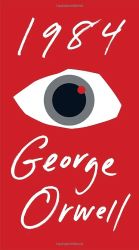
After establishing what we wanted students to achieve, we used backwards design to then create our staging for our compelling question. We wanted something that was easy for students to jump into, therefore we decided that students would work in groups to analyze different book covers of 1984. We then asked them to choose the cover that best signifies surveillance and tell the class why. We liked this idea for an introduction because it kept them thinking about the book while also adding in the thought of surveillance.
To finish the inquiry, we wanted to look more at how we are affected by surveillance today. To do that, we decided to look at the emergence of Flock cameras. So, we had students watch a TedTalk from the founder of Flock cameras and then look at a map of their area that shows where all of the Flock cameras are. Then they will watch a timeline video that shows the growth and spread of Flock cameras nationwide. After the three sources, the students work in groups to create a motto for surveillance today, much like the motto from 1984: “War is Peace. Freedom is Slavery. Ignorance is Strength.”
This inquiry mixes together the prevalent topic of surveillance with classic literature. It is so important to teach students about relevant world topics while still connecting them to the topics of the classroom. We wanted to help make the themes of 1984 relevant to today, even though the novel was written so long ago. With the work on how surveillance is seen today, we believe that students would really enjoy this inquiry.