Chances are if you’re reading this you are already an inquiry teacher who trusts IDM as a process for student engagement and learning. A series of past posts has already detailed the use of questions, tasks, and sources in specific blueprints for lowering barriers to entry for student engagement. But, how do I balance these to build a trustworthy classroom?
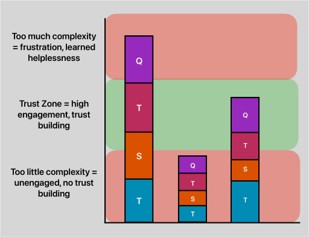
One way we can think about trust building is through an analogy of stacking blocks. Imagine we have three blocks, one for questions, one for tasks, and one for sources. Assuming the inquiry lesson is aligned and has coherence, each block is stacked directly on top of each other. The relative size of each block is determined by its level of complexity. In sum the height of these three blocks represents the level of cognitive complexity of the lesson. But this height must hit and remain in the “Goldilocks Trust Building Zone.” On one hand, if all three components, questions, tasks, and sources, are too complex the blueprint surpasses the trust building zone. We recognize these lessons as being too difficult for students at the moment. Instead of building trust, students show frustration, give up, and instead build learned helplessness. On the other hand, if the blocks are too small and each component is too easy, students finish quickly, get distracted, or work on something else. Since there was no struggle, trust was not built here either. But, if complexity is measured, and when making the blueprint a careful consideration of the complexity of each component compared to the other is taken into account, we create a blueprint that allows students to struggle yet find success. Furthermore, we can consider the complexity of each component independently, over time letting students struggle with personal, procedural, and content barriers individually to find success in surpassing them. Then we can set higher barriers and take greater intellectual risks over time, thus building trust. If we add a fourth block, trust, and set this one at the bottom it is the foundation and as it grows the threshold of the trust building zone grows too.
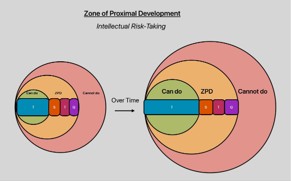
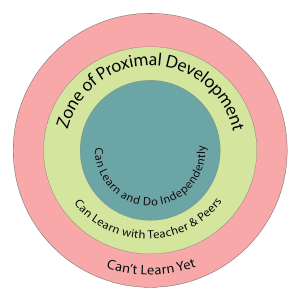
A sharp eye might see some influence of Vygotsky’s Zone of Proximal Development in this analogy. If we consider the cognitive skill to be intellectual risk-taking, then we can view everything in the “can do” zone as the level of trust that has already been built. Our use of questions, tasks, and sources puts students in the Zone of Proximal development, but too much complexity again pushes the lesson into the “cannot do” space. Over time, as students find success and build trust, their “can do” circle and level of trust expands, allowing for greater complexity over time.
This is all well and good but again a bit philosophical. It is just an attempt to describe the process that inquiry teachers go through when planning lessons so that we can invite other teachers to do the same and create and diagnose lessons with greater precision. What does this do for my actual lesson tomorrow though? Take a moment to consider the complexity of your lesson in its individual components. What do you want students to struggle with in this lesson? If it is analyzing a source, consider the complexity of your source, but also if your task is too complex as well. If you want students to grapple with a difficult question, consider planning your sources and tasks in a subjective way that allows students to come to their own conclusions. Maybe consider some sorting and category creation activities. If you have a lesson that does not go according to plan, reflect on it through the lens of the relative complexity of each of its parts and vice versa when you have a lesson that lands with students. Building trust is an intentional process that takes time. However, with the careful use of QTS we can make precise gains in lowering the barrier entry for students. Gains that build trust and allow for greater intellectual risk-taking in the future. We have to be comfortable struggling, knowing that there is a reward for the struggle in the growth we see on the other end.