
This inquiry leads students through an exploration of the idea of how people react when democracy is challenged. Students will learn about the concept of martial law. Then, they will apply what they learned to the events surrounding the martial law declaration in South Korea in December 2024. Students will analyze sources capturing the reactions of the people and the government.
Login to add Inquiry to Stack
About the inquiry
Compelling Question
What happened when democracy was tested in Korea?
Staging Question
What happened when democracy was tested in Korea? Teachers will give students time to analyze and discuss a video of Opposition Leader and current President Lee Jae-myung livestreaming himself jumping a fence, a photograph of National Assembly Speaker Woo Won-shik scaling a fence to enter the parliament building in Seoul, and a video showing how quickly Korean citizens gathered in front of the National Assembly and stood against military. Students will answer two formative questions about these sources which will launch the class discussion into the topic.
1
Supporting QuestionHow should we understand martial law?
Formative TasksStudents will read and analyze a variety of media sources related to the concept of martial law and the legacy of this concept in Korean history. After answering questions and analyzing the sources, students will use the information to create their own definition of martial law.
SourcesSource Set A:
A1: Constitution of the Republic of Korea
A2: Declaration of Martial Law
Source B: South Korea’s history of martial law explained
Source C: BBC News article and timeline of events
2
Supporting QuestionHow did South Korean citizens respond?
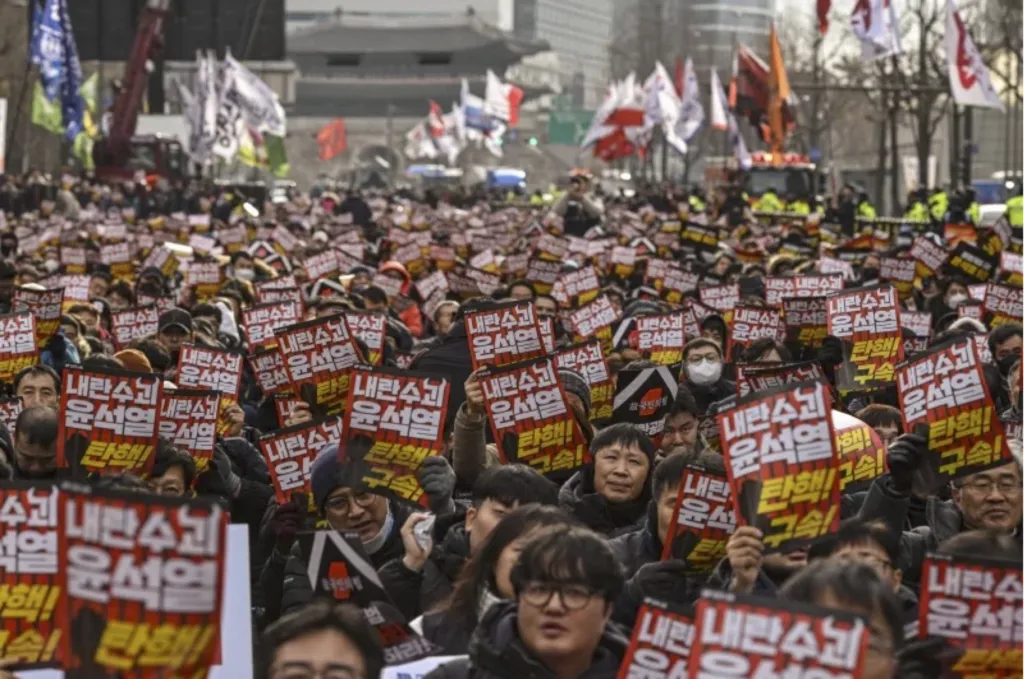
Formative TasksStudents will analyze a variety of media sources including images, narrative, video, and statistics to explore how Korean citizens responded to martial law. After completing source analysis, they will respond to the supporting question using evidence from the sources.
SourcesSource A: Images: South Korean citizens gathered to protest
Source B: Moon Seo-yeon quote
Source C: Andrew Minjun Park narrative
Source D: Ahn Gwi-ryeong text and video
Source E: Citizen protest statistics and demographics
Source F: NBC News Video of citizens protesting
3
Supporting QuestionHow did leaders, political parties, and the government of South Korea respond?
Formative TasksThrough a structured analysis of three sets of sources, students will evaluate immediate, short-term, and long-term outcomes from the declaration of martial law in the context of government. Students will take a stand on the response of the government following the declaration of martial law.
SourcesSource Set A: Politicians Responding
A1: Current President (then Opposition leader) Lee Jae-myung films the fence jumping
A2: Speaker Woo Won-shik jumping the fence
A3: BBC News Report
Source Set B: Legislative Actions
B1: Resolution to demand Lifting of Extraordinary Martial Law
B2: Transcript of National Assembly session
B3: Vote results
B4: Speaker Woo Won-shik summarizes outcomes
Source Set C: Call for Impeachment
C1: Resign or impeach quote
C2: Impeachment flowchart
Summative Performance Task
Argument: Students will answer the inquiry question through a traditional essay, infographic, or short video: what happened when democracy was tested in Korea?
Extension: Students will analyze a photo of the fence that opposition leaders scaled to enter the Parliament Building in Seoul and decide on how the fence in Seoul should be memorialized today. In this memorial, students should carefully consider the important and central role that citizens played in the movement and how this too should be remembered.
Students can research the use of K-Democracy as a keyword in President Lee Jae-myung’s administration and speeches. Additional focus on the use of K-Democracy as part of the events when democracy was tested as well as the context of other cultural terms such as K-Pop can provide additional insight.
As another extension, students can research the latest developments on former president Yook Suk Yeol and the legal proceedings that have followed to answer this question: how do the developments since the challenge to democracy influence how we should memorialize or remember the events?
Taking Informed Action
Understand: Students can research a local history event or individual who has made a significant impact on democracy in their country. Identifying and sharing their stories is an important step in preserving our democracy.
Assess: As a class or in small groups, students can assess the impact that local history events have had and consider how any local history events may be similar to the December 2024 test of democracy in Korea.
Act: Students can choose a site related to an important event or person from their own state or local communities. They will use evidence to create a poster or slides presentation about how this event should be remembered and memorialized by the public today.