
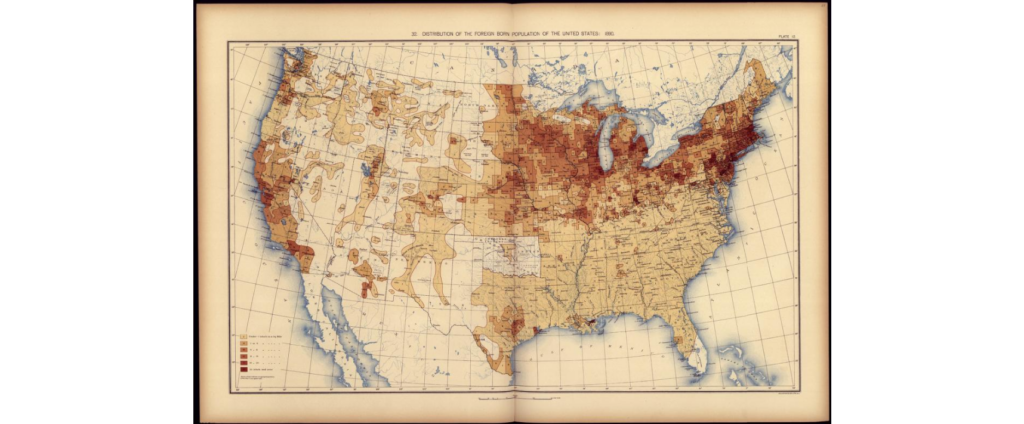
Choropleth population distribution maps use shading to show how population varies across different regions. By comparing the shades on the map, students can identify population patterns and see where people are, and are not, concentrated. These maps allow a unique opportunity for students to practice key geography skills like map reading and identifying patterns while also studying historic topics. In this building block inquiry, students analyze demographic data in the form of choropleth maps to explore where immigrants did and did not live in 1890.
Login to add Inquiry to Stack
About the inquiry
Compelling Question
What stories do maps tell? (Immigration)
Standards
D2.Geo.2.9-12. Use maps, satellite images, photographs, and other representations to explain relationships between the locations of places and regions and their political, cultural, and economic dynamics.
Instructional Snapshot
Class begins with small groups of students brainstorming where people move and why they move there to better understand the perspective of immigrants. The teacher might help prompt the discussion by encouraging students to consider what they know about historic immigration, immigrants today, or their own personal experiences moving.
After students have had time to brainstorm and record their ideas on the graphic organizer, the teacher facilitates a whole-group discussion that activates students’ prior knowledge and builds a foundation for the next steps of the inquiry. The teacher then distributes Source A to each group, and if necessary, explains how to read a choropleth map and points out the enlarged map key. Next, students analyze Source B, a population distribution map, and make three predictions on their graphic organizer about where immigrants lived in 1890. Source C, a political map of the U.S. in 1890, can serve as a student resource for place names. After students have made their predictions, the teacher distributes Source B to each group. Working together, students determine if the map corroborates, refutes, or does not address each of their predictions and explain their conclusions.
Summative Performance Task
No data found.
Taking Informed Action
No data found.