
A renaissance brings to mind transition, change, invigoration, and widespread influence. Harlem in the 1920s and 1930s was a vibrant hub of literary, artistic, and musical expression. This inquiry asks students to consider the coexistence of social and political tension with a celebratory and hopeful future as they determine what elevated the African American experience in Harlem from a cultural movement to a renaissance.
Login to add Inquiry to Stack
About the inquiry
Compelling Question
When does a cultural movement become a renaissance?
Standards
D2.His.14.9-12. Analyze multiple and complex causes and effects of events in the past.
Instructional Snapshot
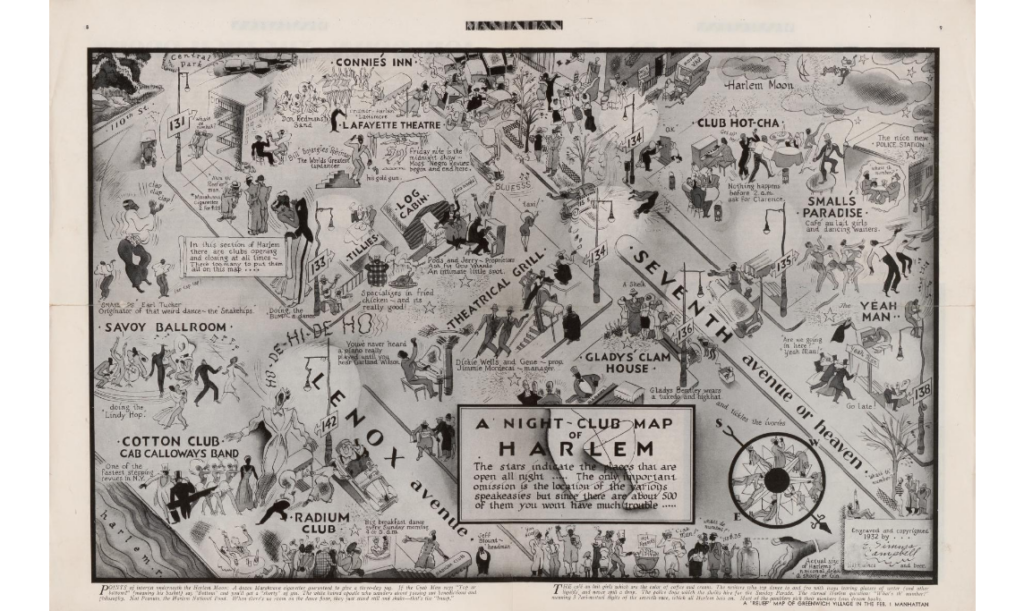
Class begins with students looking at one of four quadrants of E. Simms Campbell’s Night-club Map of Harlem. Each student completes a T-chart listing observations and questions about their quadrant, then collaborates with three other students to compile a cohesive list. Artist portraits may be used to enhance this exercise and provide more evidence for students’ observations.
Students then analyze the poetry and lyric Source Set to determine how the authors may answer the prompts “Where we’ve been,” “Where we are,” and “Where we’re going.” Students collect their thoughts on a graphic organizer.
To conclude, students circle back to the idea of a map by creating an illustration or mind map that highlights examples of how Harlem’s artists brought forth a renaissance, captioning the work with a response to the compelling question that they select or develop independently.
Summative Performance Task
No data found.
Taking Informed Action
No data found.