
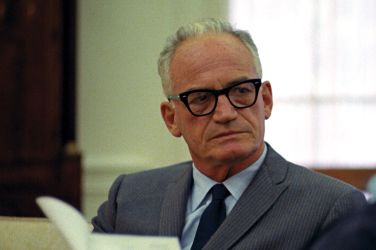
Barry Goldwater ran for president in the 1964 election with a hardline conservative platform. Although he lost in a landslide to incumbent Lyndon B. Johnson, his campaign is largely credited with laying the political groundwork for the modern conservative movement. In this inquiry, students will investigate the compelling question, “How do failed candidates influence political movements?”
Login to add Inquiry to Stack
About the inquiry
Compelling Question
How do failed candidates influence political movements?
Standards
D2.His.15.9-12. Distinguish between long-term causes and triggering events in developing a historical argument.
Instructional Snapshot
Class begins with students analyzing Source A to produce an evidentiary claim as to why someone may have voted for Barry Goldwater in the Presidential Election of 1964.
Students then analyze a series of election maps and work in small groups to identify trends across the maps from 1960 to 1972, recording their ideas in the graphic organizer as they go. The teacher may circulate throughout the activity, asking students to justify their conclusions and prompting them to consider how long-term political shifts can emerge despite short-term electoral losses. Finally, students deliberate and reconcile Goldwater’s failed election with the trends identified in the map.
Formative Tasks
PRODUCE: Write a claim that answers why someone may have voted for Goldwater in 1964.
COLLABORATE: Identify a trend in the election maps from 1960 to 1972.
DELIBERATE: Reconcile Goldwater’s failed election with the trends identified in the election maps.
Sources
Source A: “Ten reasons why we should select Goldwater for president”, 1964, Library of Congress
Source B: “Historical Presidential Elections”, 270 to Win
Summative Performance Task
No data found.
Taking Informed Action
No data found.