
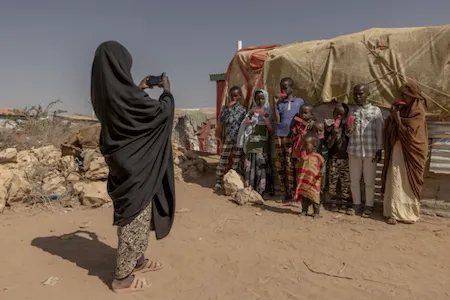
Photographers play a powerful role in capturing images of people and places in positions of vulnerability. Photographers can document significant moments and share the stories of individuals and communities experiencing hardship, such as during natural disasters, conflicts, or social crises. With this power, photographers must balance exposing truth with the responsibility for its impact.
Login to add Inquiry to Stack
About the inquiry
Compelling Question
How do photographers capture truth?
Standards
D2.His.12.6-8. Use questions generated about multiple historical sources to identify further areas of inquiry and additional sources.
Instructional Snapshot
The class begins with an editorial and podcast on photography and bias, then students develop questions about photographer bias and engage in a Harkness discussion around the question, What does it mean for a photographer to “tell the truth?” They extend their learning by exploring additional podcasts on photojournalism and conclude by writing a claim that represents how a photographer might answer the compelling question. (Download the Word or PDF files for more)
Formative Tasks
COLLABORATE: Read the Washington Post editorial and listen to a podcast from Nilupa Yasmin “On unconscious bias”. Craft a set of questions around the idea of photographer bias in journalism.
DELIBERATE: Participate in a Harkness discussion around the compelling question.
PRODUCE I Extension: Select another photographer's perspective from the podcast series and write a claim about how they would answer the compelling question.
Sources
Source A: Daniel Etter, “Photos don’t always tell the whole truth. Is that a bad thing?”, opinion editorial, Washington Post, 2023
Source B: The Photo Ethics Podcast, Photography Ethics Centre, 2024
Summative Performance Task
No data found.
Taking Informed Action
No data found.