
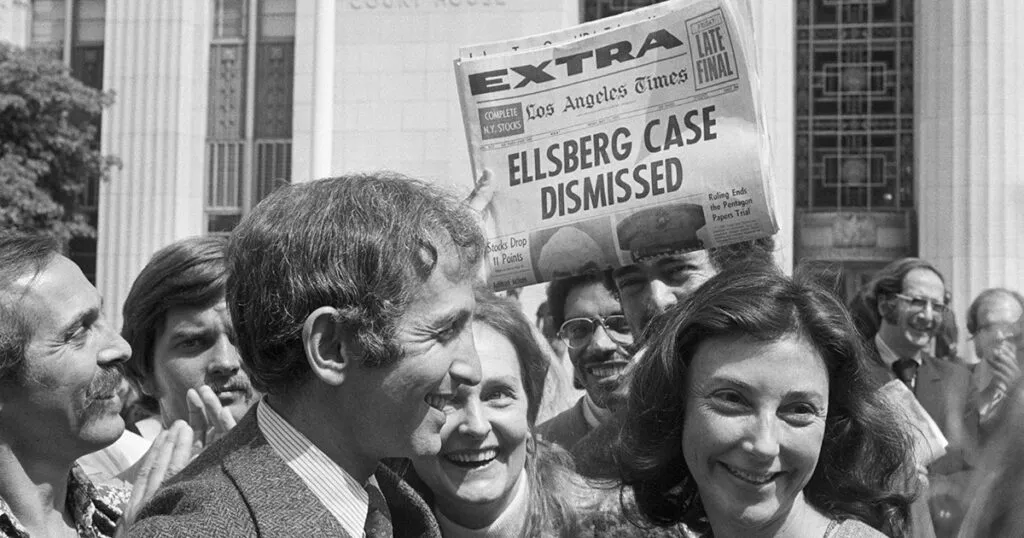
The Pentagon Papers were a secret government study of U.S. involvement in Vietnam that exposed years of deception about the war’s scope and purpose. Leaked in 1971 by Daniel Ellsberg, the papers revealed information the public had never been told. Although the Nixon administration tried to block publication, the Supreme Court allowed it. The release deepened public distrust of government, heightened opposition to the war, and highlighted the need for transparency in a democracy.
Login to add Inquiry to Stack
About the inquiry
Compelling Question
How do breaches of trust affect public perception?
Standards
Instructional Snapshot
Students begin by sorting Vietnam War book titles into government vs. non-government sources, sharing their reasoning with the class. The teacher then introduces Robert McNamara’s quote and the Pentagon Papers, and students re-sort the titles into a predicted timeline of publication. After comparing their predictions with the actual order, they reflect on how perspectives about the war shifted over time. The lesson concludes by linking Neil Sheehan’s 1971 review of critical works to Daniel Ellsberg’s decision to leak the Pentagon Papers. (For more download the PDF or Word document linked above.)
Formative Tasks
COLLABORATE: Sort the book titles into two groups - those you think were written by government sources and those written by authors not connected to the government.
PRODUCE: Re-sort the titles according to when you think the books were published to create a timeline. DELIBERATE: Compare and contrast your timeline with the actual dates of publication.
DELIBERATE: Compare and contrast your timeline with the actual dates of publication.
Sources
Source A: Vietnam War Book Titles derived in part from the Hannah Arendt Papers, Library of Congress
Source B: “Lying in Politics: Reflections on the Pentagon Papers” from the Hannah Arendt Papers, Library of Congress
Summative Performance Task
No data found.
Taking Informed Action
No data found.