
Public education in America has been a tool for fostering social cohesion and driving reform. While few would dispute that public schools have an important mission in shaping an informed citizenry, the promotion of patriotic activities in schools has sparked controversy over time. Patriotism in public education does not need to be performative, coerced, or exclusionary. Rather, it may be the authentic expression of good citizenship in day-to-day actions made by all Americans.
Login to add Inquiry to Stack
About the inquiry
Compelling Question
What does patriotism look like in the United States? (Education)
Standards
D2.Civ.7.6-8. Apply civic virtues and democratic principles in school and community settings.
Instructional Snapshot
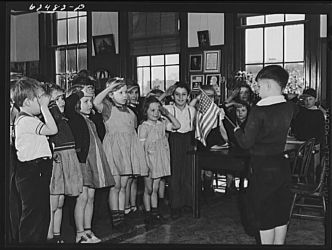
Class begins with a brief teacher-think-aloud analysis of the “I pledge allegiance” photo. Afterward, students will engage in a three-minute quick write where students respond to the prompt: Should patriotism be taught in schools?
Next, students will use what they learned from the think-aloud and quick write to participate in a barometer discussion where they stand and line up along a line according to the degree to which they agree or disagree that patriotism should be taught in schools. Students will take turns sharing their perspectives and/or making arguments. If at any time students change their perspectives, they may change physical positions to reflect their new thinking. The purpose of this activity is to activate background knowledge around ideas of patriotism that are accessible to students.
Lastly, students will make their thinking visible by working with a small group to produce a concept map. Students should make the map by utilizing images, words, colors, arrows, symbols, lines, etc. to organize and show relationships between the ideas discussed earlier in the lesson. Student groups will use their background knowledge to create a list of words, phrases, and symbols that answer the question: What does patriotism look like in education? They will sort and arrange the words and ideas visually to create a concept map with the compelling question as the central idea. Students may work in groups to read the excerpt from Teaching Patriotism and Justice and add words or phrases that expand their thinking around the compelling question to add to their map.
Formative Tasks
DELIBERATE: View the “I pledge allegiance” photo and complete a three-minute quick write responding to the prompt “Should patriotism be taught in schools?”
COLLABORATE: Students use their background knowledge to participate in a barometer discussion indicating the degree to which participants believe patriotism should be taught in schools.
PRODUCE: Work with a group to create a concept map using the compelling question: What does patriotism look like in education? Then, expand the concept maps using words or phrases from Teaching Patriotism and Justice.
Sources
Source A: John Vachon, Reciting “I pledge allegiance,” etc., public school. Norfolk, Virginia”, 1941, Library of Congress
Source B: Lucia Ames Mead, “Teaching patriotism and justice” 1907, Library of Congress
Summative Performance Task
No data found.
Taking Informed Action
No data found.