
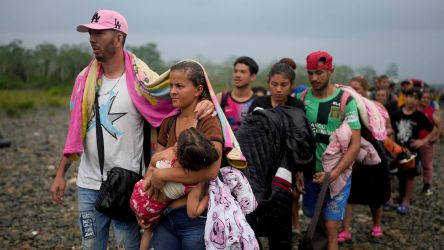
Throughout history, people have moved from one place to another in search of safety, opportunity, and a better quality of life. Today, millions of people around the world migrate across regions and national borders. In this inquiry students will investigate the compelling question, “Why do people migrate?”
Login to add Inquiry to Stack
About the inquiry
Compelling Question
Why do people migrate?
Standards
D2.His.14.9-12. Analyze multiple and complex causes and effects of events in the past.
Instructional Snapshot
Class begins with the deliberation stage, where students work in small groups to compare two maps, depicting the country of origin of immigrants to the United States, and discuss key differences over time. Students then record their findings in a graphic organizer.
Students then select one of the countries from the recent map to research further. The teacher should then move students to the produce stage, where students analyze the 2024 Human Rights Practice profile for their selected country and create an evidentiary claim based on the profile in the graphic organizer. The teacher then facilitates a class share-out for students to present their claims, have a discussion comparing and contrasting them, and create a whole-class claim that answers the compelling question, “Why do people migrate?”
Formative Tasks
DELIBERATE: Compare maps of U.S. immigration and detail differences over time. Select a current country of origin that also has a 2024 Human Rights Practice profile to research.
PRODUCE: Use research findings to write a claim about why people leave the specific researched country.
COLLABORATE: Share students' claims and create a single class claim.
Sources
Source A: Jeffrey S. Passel, Jens Manuel Krogstad, and Mohamad Moslimani, “How the origins of America’s immigrants have changed since 1850”, 2024, Pew Research
Source B: “2024 Country Reports on Human Rights Practices”, 2025, U.S. Department of State, accessed through the Library of Congress
Summative Performance Task
No data found.
Taking Informed Action
No data found.