
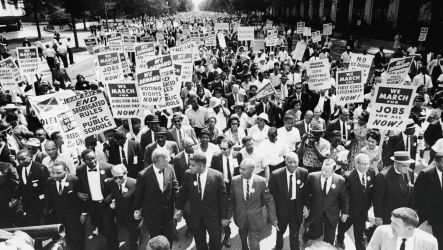
On August 28, 1963, more than 200,000 people attended the March on Washington for Jobs and Freedom. Participants gathered peacefully in Washington, D.C., to call for an end to racial discrimination and greater economic justice. Today, the event is best remembered for Dr. Martin Luther King Jr.’s famous “I Have a Dream” speech and for gaining public support for the passage of the Civil Rights Act of 1964. This building block inquiry explores the demands of the March and reforms included in the Civil Rights Act of 1964.
Login to add Inquiry to Stack
About the inquiry
Compelling Question
How effective was the March on Washington?
Standards
D2.Civ.12.9-12. Analyze how people use and challenge local, state, national, and international laws to address a variety of public issues.
Instructional Snapshot
Class begins with students sharing what they already know about the March on Washington. Students will likely have some knowledge of Dr. Martin Luther King Jr.’s “I Have a Dream” speech, which the teacher uses to transition to the march’s two interconnected demands: economic justice through jobs and racial freedom through civil rights. After dividing students into groups, the teacher provides each group with a set of cards, with each card featuring one of the demands from Source A. Students then sort the cards into two groups, giving each group a title (graphic organizer). After students have grouped the demands, the teacher distributes Source B to each group. Students compare each demand from the March on Washington with the provisions of the Civil Rights Act, crossing out any demand they determine was addressed by the legislation. When they finish, the remaining cards visually represent the demands that were left unresolved. Students then use both the completed and remaining demands as evidence to construct a claim answering the compelling question: How effective was the March on Washington?
Formative Tasks
COLLABORATE: Sort the demands of the March on Washington into two groups and label them.
DELIBERATE: Identify which demands of the March on Washington were met by the Civil Rights Act of 1964, and those that were not met.
PRODUCE: Craft a claim that answers the compelling question.
Sources
Source A: March on Washington For Jobs And Freedom, “Final plans for the march on Washington for jobs and freedom”, 1963, Library of Congress
Source B: Summary of key sections of the Civil Rights Act of 1964, accessible via the Library of Congress
Summative Performance Task
No data found.
Taking Informed Action
No data found.