
Maps can make it easy to understand complex human-geographic data. But they are also shaped by what they choose to share and leave out. This inquiry takes students through a series of political maps of the 2016 Presidential Election to consider the stories maps tell.
Login to add Inquiry to Stack
About the inquiry
Compelling Question
How do maps tell a story?
Standards
D2.Geo.2.9-12. Use maps, satellite images, photographs, and other representations to explain relationships between the locations of places and regions and their political, cultural, and economic dynamics.
Instructional Snapshot
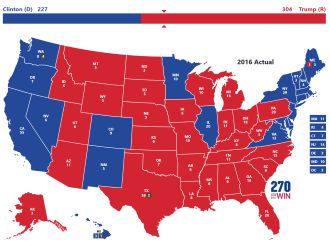
Class begins by investigating an Electoral College map (Source A) from the 2016 U.S. Presidential election, paired with popular vote statistics. As they examine the map, students are asked to craft an initial claim about the story this map tells about the 2016 Election. Students are then given Sources B-D: a precinct map from the 2016 Election, a dasymetric map of U.S. population in 2016, and voting margins and totals, to interpret the new information the maps tell about the election. Using this new information, students revise their claim, producing a more nuanced and complete story of the 2016 Election. As an extension task, students may work in pairs using National Geographic’s interactive Map Maker to create a layered map that tells a story of the United States.
Formative Tasks
PRODUCE: Craft an initial claim about what story an Electoral College map tells about the 2016 Election.
DELIBERATE: Interpret differing stories that the maps tell about the 2016 Election.
COLLABORATE: Revise initial claims in light of additional maps.
Extension: Design a layered map that tells a story about the United States.
Sources
Source A: 2016 Electoral College vs. Popular Vote, 270 to Win
Source B: 2016 Vote By Precinct Map, New York Times
Source C: Dasymetric (Population) Map of the 2016 Election, ESRI UK
Source D: 2016 Election Vote Margins and Totals, Muddy America
Summative Performance Task
No data found.
Taking Informed Action
No data found.