
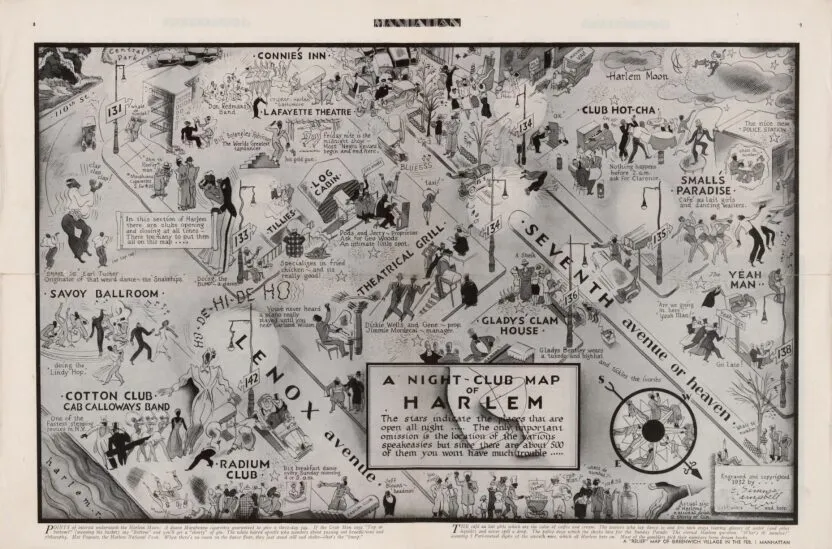
Maps serve as a powerful record of ever-changing areas. This visual narrative captures the essence of a neighborhood while providing a crucial insight into the lives of people who lived in various neighborhoods. Looking at A Night-Club Map of Harlem by artist E. Simms Campbell provides valuable insights into the Harlem Renaissance because it captures the vibrant social and cultural life of Harlem during the 1920s and 1930s. Students will be able to deepen their understanding of the economic, social, and cultural impact Harlmen had on the African-American community.
Login to add Inquiry to Stack
About the inquiry
Compelling Question
What impact did Harlem have on the African-American Community?
Standards
D2.His.14.9-12. Analyze multiple and complex causes and effects of events in the past.
Instructional Snapshot
The class opens with a map of modern-day Harlem to introduce context and the idea of the Harlem Renaissance as a cultural “rebirth.” Students analyze the map in trios using the Map Analysis Protocol, then share insights in larger groups to deepen their observations. The lesson concludes with a discussion of what the map reveals about Harlem during the Renaissance and what information it leaves out. (For more download the Word or PDF version)
Formative Tasks
COLLABORATE: In groups of three, use the Map Analysis Protocol to closely examine a map of Harlem in the 1930s, identifying areas of interest.
DELIBERATE: Discuss what this map suggests about Harlem during the Renaissance and what information the map is missing.
PRODUCE: Craft a co-constructed answer to the question to be shared with the class.
Sources
Source A: E. Simms Campbell, "Night-club Map of Harlem", Library of Congress
Summative Performance Task
No data found.
Taking Informed Action
No data found.