
Graffiti has often been seen as nothing more than vandalism, giving communities a bad reputation and reinforcing the idea that cities and urban areas are unsafe. But as more people move from big cities to smaller towns, the role of graffiti is starting to shift. Communities are now welcoming artists to create murals that celebrate local culture and bring people together. Instead of being viewed as a symbol of division, graffiti is becoming a tool for connection and expression. This inquiry looks at how the meaning of graffiti has changed over time and challenges us to think differently about its place in our communities.
Login to add Inquiry to Stack
About the inquiry
Compelling Question
How can graffiti unite a community?
Standards
D2.His.6.9-12. Analyze the ways in which the perspectives of those writing history shaped the history that they produced.
Instructional Snapshot
Begin class by introducing some key terms related to graffiti design that students will see in the sources. Use Source A to get them thinking about what graffiti is and isn’t (5 minutes). Then, split the class in half for a Jigsaw activity—one group will work with Source B and the other with Source C (20 minutes). As they read, students should gather evidence to help answer the inquiry question. This could include specific examples, personal experiences, things that surprised them, or patterns they noticed. Afterward, bring everyone back together for a class debrief. Revisit the definition of graffiti that the class created earlier, and remind students that the focus isn’t on whether graffiti is “good” or “bad,” but on how it can serve as a unifying force—whether that’s clear, subtle, or something they have to infer. If you’ve chosen a local Source D, now’s the time to show it, explaining its purpose or how it was commissioned to help bridge the conversation from analyzing graffiti to creating something new. For the final part of the lesson, students will choose how they want to apply what they’ve learned. They can create a community action plan for commissioning graffiti artwork, design their own graffiti piece, or combine both ideas (20 minutes). Give them the option to work individually or in teams, with specific roles to keep everyone involved. Optional Extension: If there’s interest, students can pitch their designs or action plans to local community leaders, with the possibility of bringing their artwork to life in the community.
Formative Tasks
DELIBERATE: Students will use a Bubble Map to describe and define what graffiti is.
COLLABORATE: Have students take part in a Jigsaw to work through Sources B and C.
PRODUCE/TAKING ACTION: Give students the following choices for what they can produce: (A) They can create a community action plan or planning sheet for a commissioned piece of art in their community, (B) They can create their own graffiti design to be presented to community leadership, (C) They could work in teams to combine options A & B.
Sources
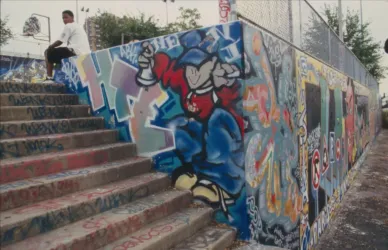
Source A: Graffiti at School 15, Library of Congress
Source B: The Frightening Impact of Graffiti on Our Local Communities, See Brilliance
Source C: The Graffiti Paradox, One Omaha
Source D: OPTIONAL Teacher choice for local choice, if there is community graffiti. (ex. Stanford, KY)
Summative Performance Task
No data found.
Taking Informed Action
No data found.