
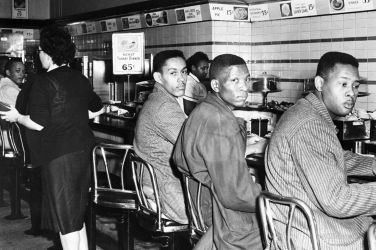
Civil rights activists used boycotts, a type of non-violent direct action, to push local businesses to desegregate. By refusing to spend money on segregated public transportation or at businesses that treated African Americans unfairly, protesters put economic pressure on those businesses to change their policies. Boycotts helped inspire more civil rights campaigns and contributed to the passage of important civil rights laws.
Login to add Inquiry to Stack
About the inquiry
Compelling Question
How effective were boycotts?
Standards
D2.Civ.12.9-12. Analyze how people use and challenge local, state, national, and international laws to address a variety of public issues.
Instructional Snapshot
Class begins with students building a class definition of the term boycott. In doing so, the teacher encourages students to explore boycotts they might be familiar with in their own lives or historic examples. Students learn that boycotts were an example of non-violent direct action that attempted to use economic pressure to get businesses to change their policies. Once students have a working understanding of the term, the teacher divides students into pairs and distributes a copy of the source set to each pair.
Students first divide the images into two groups based on the target of the boycott: public transportation and businesses. Then, students evaluate the effectiveness of each type of boycott, assigning each boycott an effectiveness score on the graphic organizer. Finally, students justify their score using evidence from the source set.
Formative Tasks
PRODUCE: As a class, define boycott.
COLLABORATE: Sort the sources into two groups based on the target of the boycott: public transportation and businesses.
DELIBERATE: Assess the effectiveness of different types of boycotts.
Sources
Source Set: Civil Rights Boycotts Photographs, Library of Congress
Summative Performance Task
No data found.
Taking Informed Action
No data found.