
Political cartoons tell stories and offer specific arguments across a range of topics in a way that text cannot. In this inquiry, students will become familiar with what we can learn from political cartoons on American imperialism.
Login to add Inquiry to Stack
About the inquiry
Compelling Question
What do cartoons tell us about American imperialism?
Standards
C3 Framework: D2.His.6.9-12. Analyze the ways in which the perspectives of those writing history shaped the history that they produced.
Instructional Snapshot
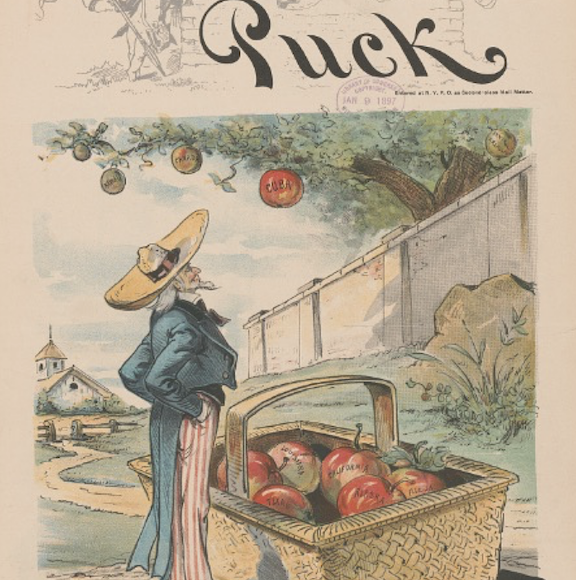
Class begins with students engaging in Harvard’s “See, Think, Wonder” protocol of Source A in pairs. Students should then discuss their findings in groups of four. Note any similarities or differences.
Next, students will work in small groups to rank five proposed captions for Source A from those that best capture the message of the cartoon to the least. The teacher may extend the conversation further regarding how the items from the “See, Think, Wonder” protocol contribute to the messages of the cartoon.
Finally, students write one-sentence captions for the cartoons in Sources B and C using the organizer that accurately capture their messages about American imperialism.
Formative Tasks
COLLABORATE: Use a “See, Think, Wonder” protocol to analyze Source A.
DELIBERATE: Rank proposed captions for the cartoon from those that best capture the message to least.
PRODUCE: Write a one-sentence caption for sources B and C that captures the message of each cartoon on American imperialism.
Sources
Source A: “I rather like that imported affair,” Puck Magazine (1897), Library of Congress
Source B: “Patient waiters are no losers Uncle Sam,” Puck Magazine (1897), Library of Congress
Source C: “Uncle Sam standing on a map of the United States,” Editorial Cartoon (1898), Library of Congress
Summative Performance Task
No data found.
Taking Informed Action
No data found.