
As civilizations started to develop in the world, people started to develop governments to create order and stability. However, this led to the majority of the society being viewed as subjects of the government. They were to perform their role/job within the civilization and were not active participants in governmental decision-making. As Athens began to develop, a concept of citizenship started to arise. It viewed people as active participants who had rights and responsibilities in the government. This early concept of citizenship helped change the view of people’s roles in government and developed the foundation of citizenship in the world today.
Login to add Inquiry to Stack
About the inquiry
Compelling Question
What does it mean to be a citizen?
Standards
D2.Civi.1. 6-8 Distinguish the powers and responsibilities of citizens, political parties, interest groups, and the media in a variety of governmental and nongovernmental contexts.
Instructional Snapshot
The class will begin with the teacher posing the following question to the class, “What qualifies a person to be able to participate in the government?” Students will work as individuals first to develop their list of reasons (about 1-2 mins), next, they will share their reasons in groups of 3-5 and develop a compiled list (2-3 mins). Once all groups are finished, the teacher will redirect to a whole class discussion where they will make a comprehensive list of the class ideas on the board (5-10 mins)
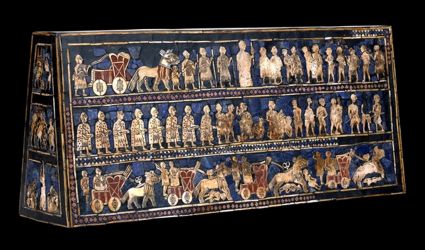
Next, the teacher will direct the students to the activity of the day. They will explain that in ancient times people’s involvement was different based on where they lived. Students will be asked to examine two resources and jot down any observations they see that would qualify a person to be involved in the government. They will use a graphic organizer to help organize ideas.
The first resource will be the Standard of Ur. Students will list their observations on what qualified a person to be involved in the government in Mesopotamia. Next students will read the excerpt from “On Civic Republicanism: Ancient Lessons on Global Politics” and explain in their own words what Aristotle believed qualified a person to be able to participate in the government.
Students will then construct a claim on how they believe the role of ordinary people has changed and connect it to their belief on what qualifies a person to be in the government.
Formative Tasks
COLLABORATE: Working in small groups and as a whole class, students will create a compiled list of what qualifies a person to be able to participate in the government.
DELIBERATE: Using a graphic organizer, students will examine the Standard of Ur and read the excerpt from, “On Civic Republicanism: Ancient Lessons on Global Politics” to develop ideas to compare what qualifies a person to be able to participate in the government.
PRODUCE: Students will construct a claim on how the role of ordinary people has changed and connect it to their belief on what qualifies a person to be in the government.
Sources
Standard of Ur & On Civic Republicanism, Library of Congress
Summative Performance Task
No data found.
Taking Informed Action
No data found.