
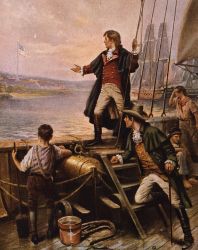
The phrase “Land of the Free and the Home of the Brave” comes from The Star-Spangled Banner, written by Francis Scott Key during the War of 1812. Over time, these words–freedom and bravery–have become hallmarks of America’s identity, reflecting the nation’s ideals of liberty and courage. Yet, the journey to embody these values has been complex and, often, contradicts the common perception that our freedom comes thanks to the bravery of some special individual’s bravery. Authentic progress, though, is rarely the work of one hero but entire movements exerting collective courage. In this first lesson of this BBI stack, we establish what the terms collective bravery and universal freedom mean, and ask students to consider whether, at the time the Star-Spangled Banner was written, America was truly, as the poem claims, the “Land of the Free, Home of the Brave?”
Login to add Inquiry to Stack
About the inquiry
Compelling Question
Was America the "Land of the Free, Home of the Brave?"
Standards
D2.His.1.6-8. Analyze connections among events and developments in broader historical contexts.
Instructional Snapshot
To begin, pose the questions, “What do you think it means to be collectively brave? and “What do you think is meant when a country has universal freedom?” Allow students time to think and write individually, supporting them with your own examples as needed. Then, with a partner or table groups, have the students discuss their answers. Come back together as a whole class, and invite students to add their thoughts–words, phrases, or rough definitions–to two word webs. Ultimately, you should establish your classroom definitions for the two concepts (10-15 minutes).
Project Source A and introduce the poem “Defence of Fort M’Henry.” Students should recognize it as the basis for what would become the Star-Spangled Banner. Read the third stanza together, and ask students for their initial reactions. (5 minutes) Next, hand Source B to the class, asking them to note the nature, language, and date of the newspaper advertisement. Invite them to share their reactions as a class. Finally, invite students to speculate on which identity groups would and would not have been considered part of the “land of the free” in the early 19th century. Create a T-chart on the board to mark down their responses. (10-15 minutes)
Finally, students should work together in small groups to construct a new “Whereas” clause for Source C, in which the U.S. Senate celebrated the 200th anniversary of Key’s poem and the War of 1812. This clause should not disregard the historical achievements of Key and those who fought the war, but it should acknowledge the historical context of the time period, who had freedom, and who did not. If time permits, groups can share their clauses with the class.
Formative Tasks
COLLABORATE: Work as an individual, pair, and then whole group to define what “collective bravery” and “universal freedom” might mean. Invite students to add their words, phrases, and definitions to word webs on the board.
DELIBERATE: Speculate on which of those living in the U.S. during the War of 1812 would have been considered full citizens in the “land of the free”--and who wouldn’t have been–using Sources A and B.
PRODUCE: Construct a new clause for the bicentennial Congressional Resolution that includes information about the nature of “freedom” at the time the poem was written and the War of 1812 was fought.
Sources
Star Spangled Banner Source Set, Library of Congress
Summative Performance Task
No data found.
Taking Informed Action
No data found.