
This inquiry explores how television can inspire social change, focusing on the Children’s Crusade in Birmingham, Alabama. Students will analyze how footage of children enduring fire hoses and police dogs revealed the brutal realities of segregation and moved President John F. Kennedy to advocate for the Civil Rights Act. Through this, students will understand the power of media to influence leaders and drive legislative change.
Login to add Inquiry to Stack
About the inquiry
Compelling Question
How can television be a call to action?
Standards
D2.His.16.9-12. Integrate evidence from multiple relevant historical sources and interpretations into a reasoned
argument about the past.
Instructional Snapshot
The class begins with students analyzing news broadcasts and Kennedy’s Civil Rights Address using a dialectical journal to select quotations and reflect. Students then adopt roles tied to the Children’s March (e.g., marcher, police officer, parent, leader, official) to consider different perspectives using a Think-Feel-Care approach. In groups, they discuss how these perspectives shape understanding of the system and help answer the compelling question. (For more download the Word or PDF version)
Formative Tasks
COLLABORATE: Students discuss perspectives from the "step inside a system" activity, sharing insights on how roles influence the understanding of the system.
DELIBERATE: In groups, students explore how roles shape responses to the system and its impact on the Children’s March.
PRODUCE: Students reflect and analyze through a dialectical journal, then produce insights by adopting roles and exploring perspectives.
Sources
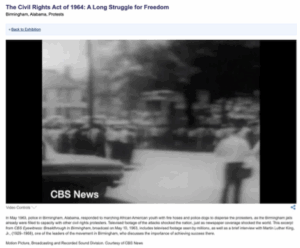
Source A: Birmingham, Alabama, Protests, Library of Congress
Source B: Television and Birmingham, Library of Congress
Source C: President Kennedy’s Civil Rights Address, Library of Congress
Summative Performance Task
No data found.
Taking Informed Action
No data found.