
Industrialization allowed factories to produce goods faster and more efficiently, helping some companies grow dramatically. Accompanying this growth were changes in the way businesses could be organized. Large companies called trusts came to define the economics of the Gilded Age. Trusts (or monopolies) controlled entire industries, reduced competition, and expanded their profits. While the owners of trusts benefited from this system, trusts had far-reaching negative consequences for others.
Login to add Inquiry to Stack
About the inquiry
Compelling Question
What did big business cost the US?
Standards
Instructional Snapshot
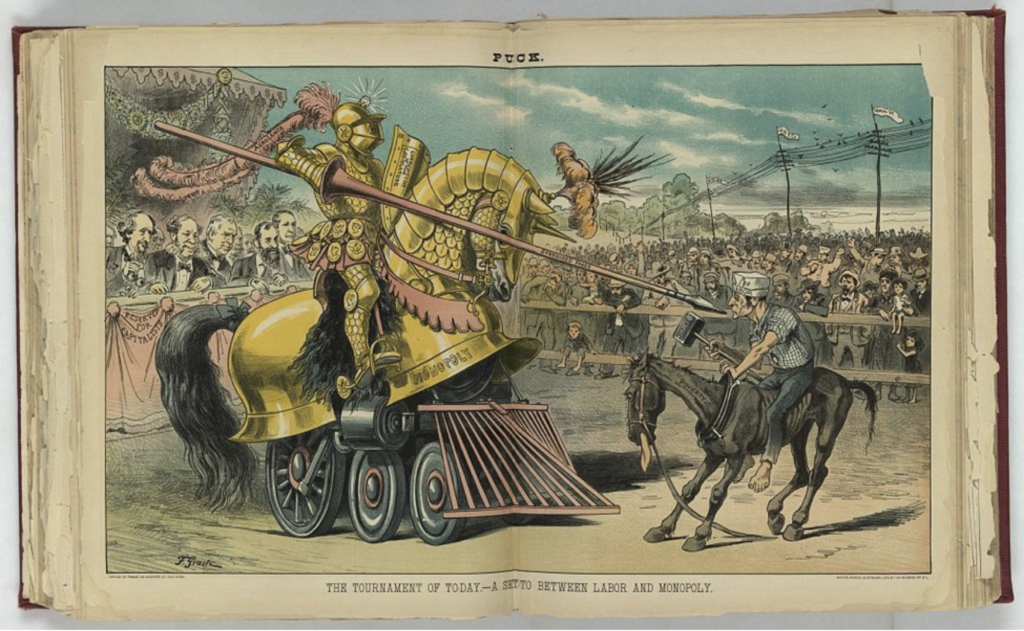
Class begins with the teacher defining the term trust or monopoly to the whole class. The teacher then divides students into pairs and distributes a copy of the Source Set to each team. Using the definition of trust as their background knowledge, students analyze each of the political cartoons that critique trusts during the Gilded Age. For example, students may note that the power of industrialization cost business competition, trust of public opinion, or trust in government. Students use the definition to identify two symbols used by each cartoonist and describe how the symbol is used to critique a trust, recording their observations on the graphic organizer.
Finally, students select the political cartoon that is the most effective critique of trusts to a modern viewer and justify their choice in a claim.
Formative Tasks
COLLABORATE: Identify and decode symbols that critique trusts in the political cartoons.
DELIBERATE: Determine which political cartoon presents the most effective critique of trusts to a modern viewer.
PRODUCE: Craft a claim that justifies the choice of the most effective political cartoon.
Sources
Gilded Age Political Cartoons
Summative Performance Task
Argument:
Extension:
Taking Informed Action
No data found.