
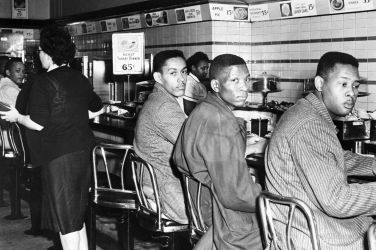
The Greensboro sit-ins began on February 1, 1960, when four African American college students sat at a segregated lunch counter in Greensboro, North Carolina, and politely refused to leave after being denied service. Sit-ins quickly spread across the South. Sit-ins became an important strategy during the Civil Rights Movement because they challenged segregation through nonviolent direct action. Many sit-ins led to the desegregation of public facilities and helped build support for stronger civil rights protections.
Login to add Inquiry to Stack
About the inquiry
Compelling Question
How effective were sit-ins?
Standards
D2.Civ.12.9-12. Analyze how people use and challenge local, state, national, and international laws to address a variety of public issues.
Instructional Snapshot
Class begins with the teacher distributing a sticky note to each student. On the board is a spectrum with one end labeled force and the other labeled presence. The teacher asks students, “If you want to change a rule you think is unfair, should you use force, or can you just use your presence?” Then, students take a stance by placing their sticky note on the spectrum. After defining sit-ins as a form of non-violent protest during the Civil Rights Movement to provide context, the teacher then divides students into small groups and distributes Source A and Source B. Students analyze the images using a See, Think, Wonder thinking routine, documenting their insights on their graphic organizer. The teacher then screens Source C for students to show how sit-ins spread beyond Greensboro, NC. Next, students evaluate the effectiveness of sit-ins during the Civil Rights Movement by analyzing Sources D-F in terms of immediate reactions to the protests. Students then revisit the original spectrum, revising their position if needed based on their evaluation of the effectiveness of sit-ins. Students then reflect on how their perspective has/has not evolved.
Formative Tasks
COLLABORATE: Engage in a See, Think, Wonder around photographs of the Greensboro sit-ins.
DELIBERATE: Evaluate the effectiveness of sit-ins as a form of non-violent protest.
PRODUCE: Revisit students’ initial perspectives on the spectrum regarding non-violent protest, revising, if needed.
Sources
Sources A-B: Photographs of Greensboro Sit-Ins
Source C: News Broadcast of Nashville Sit-Ins
Sources D-F: Recollections of the Greensboro Sit-Ins
Summative Performance Task
No data found.
Taking Informed Action
No data found.