
This inquiry leads students through an investigation of the ways in which artists of the Harlem Renaissance shared their voices and how they felt empowered to do so. Students analyze different types of art produced during the Harlem Renaissance. Students start to think about the role artists can play in shaping a decade and their power in sharing experiences with the world.
Login to add Inquiry to Stack
About the inquiry
Compelling Question
How did the Harlem Renaissance help African Americans share their voices?
Standards
Skills USII a: synthesizing evidence from information sources including, but not limited to artifacts, primary and secondary sources, charts, graphs, and diagrams to understand events in United States history;
USII 5e: examining the art, literature, and music of the 1920s and 1930s including, but not limited to the Roaring Twenties and the Harlem Renaissance
Instructional Snapshot
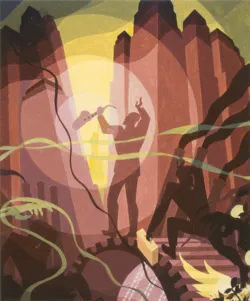
Class begins with the introduction of Langston Hughes. The teacher explains a short biography of him or watch this video. The teacher explains that he was part of a movement known as the Harlem Renaissance and introduces the key words for the day: expression and renaissance and then poses the compelling question. From there the class reads the Langston Hughes poem “I, Too” and discusses what is being expressed and how it shows the Harlem Renaissance. Next, students analyze the two sources: Song of the Towers painting by Aaron Douglas and Duke Ellington’s Song– “Black and Tan Fantasy” (1927). In small groups students work to understand these different forms of expression and answer the discussion questions. Finally, students share out answers found from their group’s analysis and then construct an answer to the CQ. Ultimately, teachers could expand on this conversation and the compelling question by bringing in other examples of artists during this time or by looking at other racial groups of the 1920s.
Formative Tasks
COLLABORATE: Read the Langston Hughes poem “I, Too” and use it to create definitions of expression and renaissance
DELIBERATE: Analyze Source B & C to uncover what the artists were saying about the African American experience and relate it back to the class definitions
PRODUCE: Construct an answer to the CQ with evidence collected from the sources and the overall class discussion
Sources
Source A: “I, Too” a poem written by Langston Hughes in The Weary Blues, 1926.
Source B: Song of the Towers painting by Aaron Douglas
Source C: Duke Ellington’s Song– “Black and Tan Fantasy” (1927)
Summative Performance Task
No data found.
Taking Informed Action
No data found.