
For much of American history, the indigenous peoples of the United States faced immense challenges, from genocide to forced relocation to family separation. In the face of a mortal threat to their existence, however, indigenous people demonstrated incredible bravery. Tribal groups often formed alliances to push back against mistreatment and lobby for land, rights, and freedom. In the 20th century, the American Indian Movement fought for indigenous civil rights alongside the better-known Black Civil Rights movement. Simultaneously, many tribes collectively organized to resist terror campaigns from groups like the Ku Klux Klan. This lesson features examples of collective bravery by regular people to ensure that their universal freedom would be guaranteed.
Login to add Inquiry to Stack
About the inquiry
Compelling Question
Can freedom come without collective bravery? (Native Americans)
Standards
D2.His.12.6-8. Use questions generated about multiple historical sources to identify further areas of inquiry and additional sources.
Instructional Snapshot
To begin, split the class into four groups and distribute one of Sources A-D to each group. Ask each group to examine the source, prepare to summarize it for the class, and notice the date. After five minutes, have the students create a visual timeline on the board by taping the sources to the board in chronological order. Invite students to discuss their takeaways from the timeline–a main one being that despite technically earning U.S. citizenship in 1924, barriers to freedom remained in place long after. (10 minutes)
Distribute the graphic organizer and introduce Source E (from 37:56-44:05), in which Lumbee scholar Malinda Maynor Lowery recounts the event known as the Battle of Hayes Pond. Pause as necessary to ask clarifying questions, confirm student understanding, and allow students time to complete the organizer. After the video, ask students to share their reactions to the video–based on their graphic organizer questions and their responses–with a specific focus on the final question: “Why are instances of collective bravery like this important for us to know?” (15 minutes)
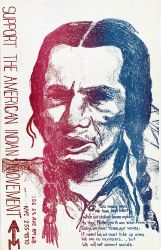
Finally, inform students that to your knowledge, no physical artifacts or primary sources from the Battle of Hayes Pond exist in the Library of Congress archives. In groups, assign students the task of finding or creating an artifact to commemorate The Battle of Hayes Pond. Project sources G and H, posters of the American Indian Movement, as examples of artifacts. (20-25 minutes.)
Formative Tasks
COLLABORATE: Organize a timeline of Native American voting rights using the provided sources.
DELIBERATE: Discuss the actions taken by the Lumbee to protect themselves and their community, during and after the video describing the Battle of Hayes Pond.
PRODUCE: Find (or create) a resource that could serve as an artifact in the Library of Congress to commemorate this event.
Sources
American Indian Source Set, Library of Congress
Summative Performance Task
No data found.
Taking Informed Action
No data found.